
Exploring Installation

As Installation works are appearing more frequently in conjunction with the development of new technologies, it is easy to think of installation art as a relatively new art form. However, the modern era of Installation can be dated back to the 1960s, with roots in Cubism, Dada, and Constructivism. In his book Understanding Installation Art, Mark Rosenthal says that because the sources, motivations and types of installation art have been diversified and multi-dimensional in the last 80 years or so, there is no commonly accepted definition of it, however, the following definitions and parameters are meant to provide some context.
Rosenthal defines installation as “a dedicated space in which one artistic vision or aura is at work, setting forth various kinds of phenomena”. He also proposes a taxonomy for categorizing installations, but the reality is that installation is much more fluid than the categories in which he attempts to confine it. In her book Installation Art, Between Image and Stage, Annie Petersen acknowledges the fluidity and elasticity of installation art, and defines an installation as “both an organization of elements in and in interplay with the space, and an organization of that very space.” Many art historians and installation artists focus on space or the concept of space-time as defining characteristics of an installation. Ran Faye discusses how installation blurs the barrier between real life space-time and “art-life” space-time in his book A History of Installation Art and the Development of New Art Forms. It is also worth noting that both space and time are culturally constructed, which affects the implications of an installation work and how it is experienced by the audience. Another key characteristic of installation is Faye’s idea of a “totalizing aesthetic”, which is the idea that multiple art forms are combined to produce a heightened sensorial experience for the viewer.
One of the most important parameters of installation is of course the experience of the audience and breaking the convention of a “fourth wall”, which is present in almost every other traditional art form. Other art forms are viewed through physical and perceptual barriers, and the art object or performance is distanced from the viewer, existing in an “art-life” space-time rather than being integrated in real space and life experiences. What I love about installation art is that it attacks and dismantles the fourth wall, as well as traditional art-viewing spaces such as museums, galleries, and theaters. In order for art to be fully experienced and engaged with, the fourth wall must be torn down.
These parameters are by no means all-encompassing of what installation has the potential to be - that is beyond the scope of this paper, but they provide some general context for exploring the ways in which installation artists approach a work, and in examining how I am approaching installation as an artist who is new to the art form.
The loosely defined parameters of what constitutes an installation give the artist freedom to define their own processes, materials, and viewing context of their work. The unique artistic autonomy that this form grants the artist means that approaches are widely varied, and artists often come from different backgrounds, bringing with them the techniques and practices of other disciplines.
I am nearly half way through the process of designing and creating an installation for a semester-long Installation Art class, and this is the first installation work I have had the opportunity to build. I had no formal knowledge of the art form or its parameters before starting, and my knowledge is still extremely limited, yet I have an intrinsic understanding of and connection to Installation as a multi-hyphenate artist who has always felt limited by the confines of a single art form. I have felt drawn to installation as a medium of exploration in the arts because of its all-encompassing nature, which makes it more accessible in some ways than traditional art forms. While installation in its lack of formality makes it more approachable, the characteristically large scale of Installation works and the need for a space in which to create them can reduce accessibility for artists engaging in this art form.. Having been provided with a space in which to experiment, I now have the opportunity to explore the world of installation art from an artist's perspective.
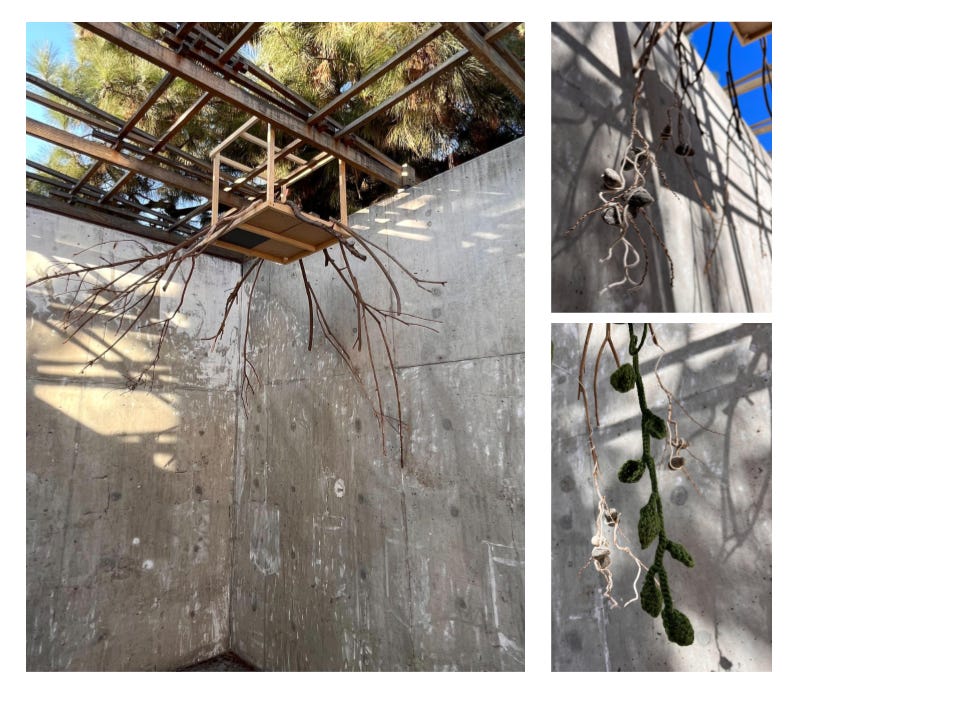
Sensory Roots (working title), 2023
I have a general vision of my hopes for the finished work, influenced by my past experiences and my relationship to the natural world, as well as my exploration of methods and materials.
Materials and Construction
The space in which I have to work and which I share with the other artists in my class is a small outdoor concrete building with an architectural wooden beam structure in place of a solid roof. My installation is mounted from those beams and is representative of tree roots, which reach down into the space and surround the viewer.
The roots are made of scrap wood and scavenged tree branches, the largest of which are attached to a structural box built with scrap wood. The larger branches trickle down into smaller ones, in which rocks, bits of earth, and scraps are entangled using wire, string, and yarn. Also hanging from the roots will be crocheted vines.
Sourcing the tree branches has been the biggest challenge, which recently led me to the decision to carve some larger tree branches out of scrap beams that were left over from an old architecture project at the studio (these are not pictured). This idea was inspired by Thomas Dambo’s piece called Tree Trees, in which he created a mini forest of abstract trees out of scrap wood from a music festival.
A component which I have yet to source materials for and create is a large organically shaped tufted rug that is reminiscent of a patch of moss, on which the viewer is encouraged to sit and meditate or simply feel more grounded as they enjoy the space.
My sustainability goal for this project is to use as much scrap material and found objects as I can to create the root system, integrating man-made materials with natural ones, and including a variety of textures to interact with. Although the components of my installation are mostly visual and tactile at this stage of the process, I will be adding sound in the next two weeks to enhance the meditative quality of the space. The sound may be produced digitally, or it may result from a specific physical interaction with materials by the viewer.
Inspirations
The concept of the work is not yet fully developed, but perhaps explaining my inspirations will provide some context.
For several years, I volunteered with a non-profit called Respite Care, which provided day-care to neurodivergent children of all ability levels and needs. Working with neurodivergent children and observing the importance of sensory stimulation in experiencing the world has piqued my interest in exploring sensory interactivity in the arts ever since. Our senses are how we see the world and connect to everything around us, so it does not make sense for the main modes of experiencing art to be limited to visual and aural processing. In an interview for Art Papers with Wendy Jacob, who creates interactive installations in collaboration with and for people with disabilities and sensory impairments, she says that “although we tend to rely primarily on vision and sound for information, there is something elemental and direct—maybe even more truthful—about touch, smell and taste.” While the installation I am currently working on is still heavily influenced by my background in the visual arts, I am especially interested in bringing tactile senses into the environment.
The other major theme I am exploring through this project is the concept of our shared human experience of the natural world. In modern society, especially western society, we place so much importance on technology, so much so that it consumes us. Technology is also playing a big role in immersive video installations, but I find myself fighting against that current, favoring art experiences that nurture the senses rather than overstimulate them.
The concept of shared human experience is something that many installation artists explore, and the medium of installation lends itself to that exploration because of its elasticity and ability to physically engage viewers to evoke a certain response.
Methods
Since this is such a new field to me, I did not adopt my approach from installation artists as much as I did from my own experiences in other artistic disciplines, mainly visual art, sculpture, and theater.
Many installation artists take an improvised approach to creating their art, such as Kurt Schwitters, an installation artist and Dadaist who used chance as an element within his creative process and acted on “aesthetic impulse” (Faye). I have always been a perfectionist about art, and my approach is much more rigid and planned. At the start of this project, I knew I wanted to hang something from the grid in the space, but felt I needed a 3 dimensional aid to help me plan, so I got up on a ladder and measured every single dimension of the space that I needed to create a half-inch scale model, pictured here. Model-making is a skill I learned through scenic design for the theater, and I have found that being able to play around with different elements in a scaled version of the space saves me time and frustration in the long run. If I do not plan something out, especially if I intend to build upon it or if it needs to have some structural integrity, I will change my mind about the construction a week later, tear it apart, and start over.
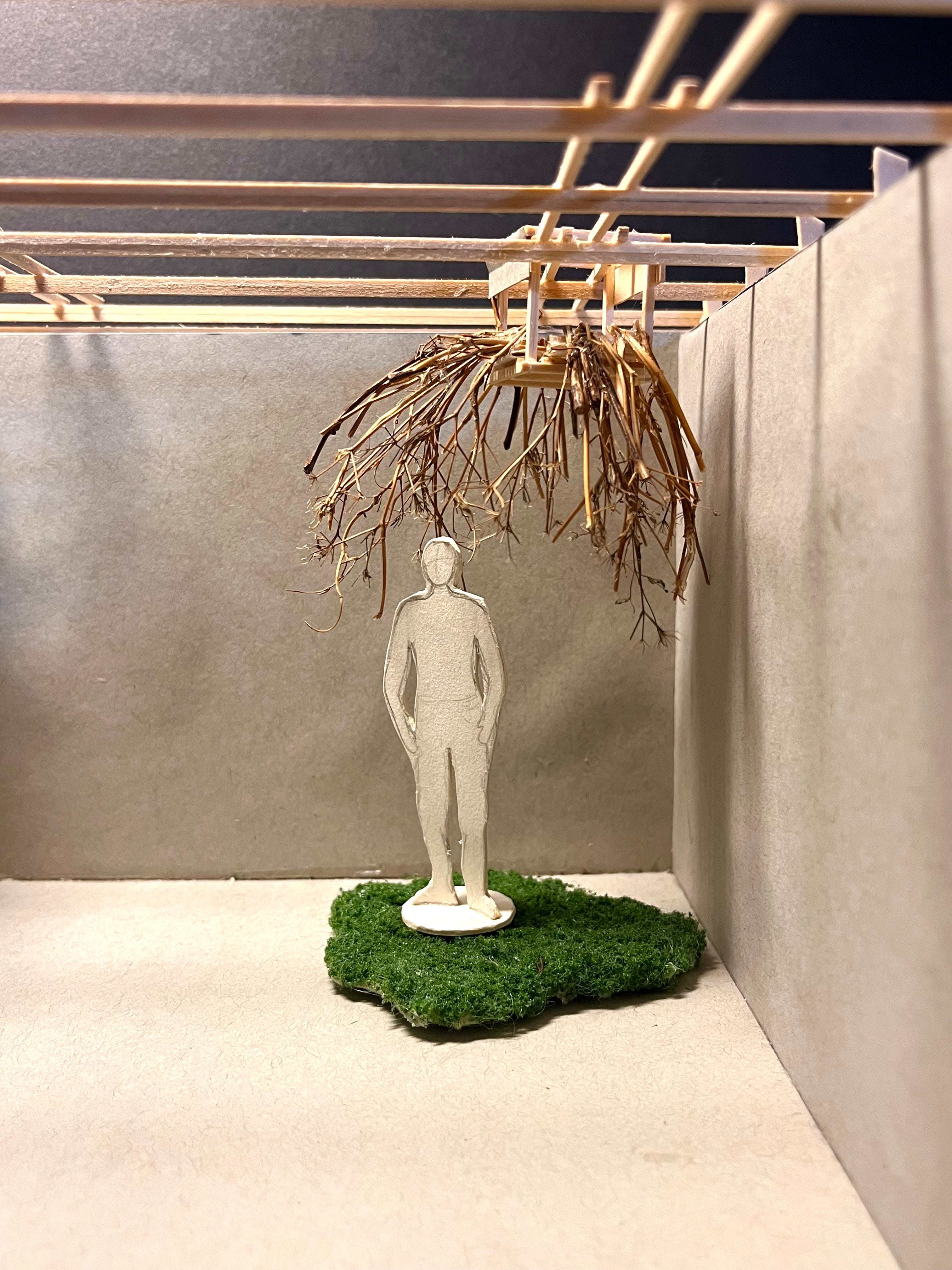
The downside to my method of extensive planning is that I have the tendency to lock myself into one iteration of a work and not allow for a radical shift in the concept, materials, or composition. When I have a vision of what I expect the work to look like, I often end up being disappointed. For this reason, I have not added to the scale model of my installation for the past two weeks. Instead, I have spent my time experimenting with materials, making smaller components that I have the choice of adding to the larger structure once it is complete. I obviously still have a lot of work to do on carving and sourcing the larger roots, but the challenge of sourcing materials and giving myself a longer time frame by extending this project over several months has helped my structured, anxious style of creating art to unravel slightly, which is something that I hope to continue experiencing as I create more installations.
Experience
My hope for the audience experience of this installation when it is complete is one of meditation, grounding, and reflection, as well as the joy of sensory interactivity with art. I want this work to encourage people to interact with their environment and reflect on their bodily and spiritual connection to an art space and to the natural world. My interest in Installation is rooted in the desire to create a more inclusive form of art, and this installation is just the first step on that journey.